And now we are all on video conference calls because of COVID — Student Survey on Video Conference usage in 2020
In 2020, we relied on video conference software with new magnitude. After video conference platforms crashed nationwide, I wanted to know how much more disruptive a nationwide crash was beyond missing a class. I wanted to uncover some general uses, advantages, and disadvantages for online conference software. My process included crafting a survey using the survey design tool, Qualtrics, and sharing out the survey through a convenient, purposive sample of Facebook users that had access to the survey weblink for two weeks.
A directional sample size suited my need
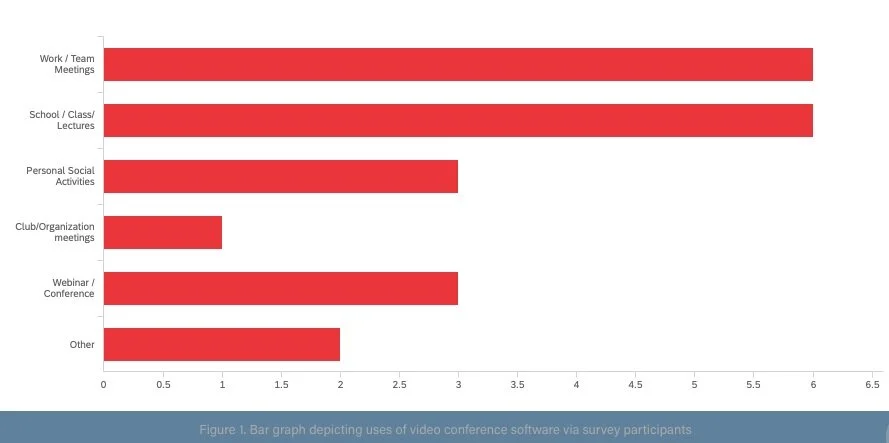
I collected a total of 14 survey responses. All of which had recently used various video conference software tools for both personal and professional needs. My population was represented by a mix of young adults 18-32 (n=8) and older adults 33+ (n=6). Generally, these participants used the tools for work meetings and classes, however used it for alternative learning opportunities (webinars) and social activities and clubs.
Findings
Benefits:
Saving time and money from the remote flexibility
For example - saving money and time not traveling to conferences without travel, hotels, or food
Muting themselves or turning off the camera when they need a break
Easily connecting with others and doing it safely, in covid precaution times
In addition to the list above, participants shared verbatims on their perceived advantages to video conference software. For example “saving money and time not having to commute and parking”, “the flexibility to meet when convenient and from various locations”, “comfort to be at home amide a global pandemic and the use of reaction buttons”, and “it’s easier to collaborate with people from a distance”.
Disadvantages
In general, participants noted increased academic issues, technological issues, and complications with personal and health issues with the use of these video conference tools. Some of the disadvantages included:
Misalignment in experience and cost
Students in particular called out the cost of universities was the same to a standard tuition for an in-person experience.
Technological distractions and issues experience with video conference software
Lack of focus that may be out of their control restricted access to computer and wifi, the need for stable internet which is beyond the personal ability, and lack of control if the other party has a bad connection or can’t find a silent place to call-in. Several participants disclosed that technological difficulties and computer crashes are a huge barrier.
Participants shared a more personal note disclosing complications with video anxiety, eyestrain from being on screen more hours throughout the day, the experience of an intruder ‘Zoom bomb[ing]” the call or being on calls with too many people that they struggled to be seen or heard.
When asked to elaborate on disadvantages indicate issues with video conference software, participants said that academically that would enjoy that professors give more attention to students through structured lecture, more care for technological lag like issues with speech and video aligning, the sound being unclear or choppy, and losing students or others on the call which disrupts the flow. In addition to academic issues, public health issues arise with eyesight issues and having specific glasses to combat video fatigue. Last, a need for a better mutual agreement for hardwiring computers, sharing videos, being on time would improve the overall experience for meetings where all members are present and understand some type of ground rules.
Outcomes
While this was an exploratory research practice, I learned more about how video conference software functions in a variety of useful ways for people navigating the online workforce and academics during COVID-19 in 2020. The use of these tools are both helpful and disruptive, but people make it work with their given situation and have been able to adapt technology to fulfill personal and professional needs.