Focus Group:
Gaining the Student Perspective on Student Debt
Presented: March 2019
Our Approach
My team enacted a mixed methods approach incorporating an open-ended survey, in addition to a focus group with the survey student population. The use of a mixed methods approach was used in order to maintain credibility and produce a trustworthy study. Our team consensus to use a survey in addition to the focus group was to elicit student ideas that may not have been present due to speaking dynamics of the group space discussion related to financial issues as potentially discomforting to participants. The survey allowed participants to express their thoughts, anonymously. This project had a limited timeframe, thus we felt a focus group could compliment the survey to probe for the general themes that student perceptive on the national and personal debt crisis.
Data Collection
Our focus group collaboratively generated data by having a moderator ask the same questions from our survey in a semi-structured format, allowing participants to respond according to their comfort and experience. We used two cell phones, on opposite sides of the room, to record the discussion verbatim and to create an mp4 file for future transcription. One team member took notes on a laptop from the back of the room to indicate spoken themes, body language, and other details that could not be recorded in the audio data. Another team member recorded answers on a whiteboard so that participants could collectively view a summary of the main points that were being discussed, allowing them to fill in gaps and correct misrepresentation.
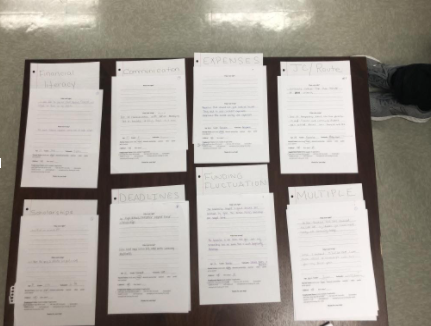
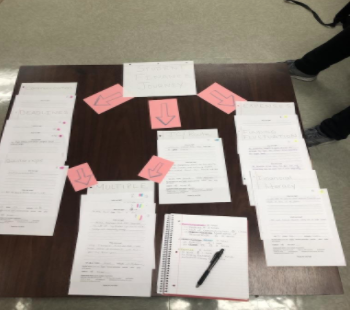
Images 1 and Image 2: Our teams sorting of notes to code the responses from the student participants.
Findings
The general tone of the focus group was one of concern and apprehension. It is possible some of that emotion came from inhibition to share personal details about a sensitive topic like financial aid and debt. However, in reviewing the summary of our whiteboard notes, it is clear that the students perceived more problems and things that go wrong with financial aid than things that go right. The following were expressed in their summary:
That college is too expensive.
Students exclaimed that greater consideration needs be taken into consideration about what it takes, financially, to live in San José and the Bay Area. Students stated a regional assessment of the cost of living can be conducted that would include ability to manage payments off of minimum wage and family financial obligations like supporting more than one student at home. In addition, that high schools can do a better job to communicate with students and families about financial aid for higher education and financial responsibility. Also, students stated that SJSU can do a better job of advertising profitable jobs outside of ‘tech’ and offer more online classes to accommodate students who need more flexibility in their schedules (ie. to attend to part-time work and family obligations).
Our initial recommendation is to continue this study with:
A more thorough assessment of Bay Area financial realities and students’ financial well-being or precarity. Such an assessment would take into account minimum wage, students’ part-time and full-time wages, students’ time allocation, health, stress, and other factors that may provide a more complete picture of students’ overall well-being.
A more thorough assessment of students’ individual and family financial realities as they change over time. This could involve illustrating who is included in a student’s financial aid network and assesses what percentage of the educational financial burden each member bears and what roles they play. It would be helpful to understand the financial precarity of each member of that network and how it changes over time.
A more structured and thorough review of scholarships, financial aid, and jobs in high school and regularly throughout the school years in university. The behavioral science students in our group expressed a need for scholarship and job information specific to their major, including opportunities outside of ‘tech’ and to communicate that information early and regularly.
Providing information about online classes and expanding online class offerings to allow students to live in more affordable cities.
What we learned in the process
Overall, our team learned that the following tactics worked in our favor:
Analyzing right after focus group, together
Pile sorting technique of themes throughout surveys
Access to a “cohesive” group of participants around student affairs
The physical survey for students to write, having audio recording, and written -live- notes
While we learned that may have been too many students in the group, we were still able to gain valuable insights into students’ perceptions and expectations for choosing both to attend college and take on debt in exchange. Future focus groups should be limited to smaller groups than fourteen, possibly split into two groups of seven students. We also found that our questions could benefit from being even more focused once we moved based main themes or domains specified by student participants.